
Professor Quintard Taylor, 1948-2025, A Remembrance
The year just concluded saw the untimely passing of Quintard Taylor, professor emeritus of the University of Washington.
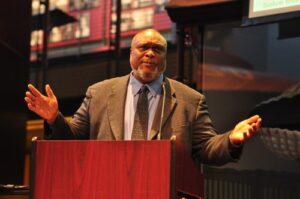
Professor Taylor, a giant among scholars, died September 21, 2025 after re-locating to Houston, Texas. He was 76.
In addition to a distinguished career in academics, Professor Taylor was best known for founding BlackPast.org, an online archive with more than 10,000 entries focusing on African American history.
He was also recognized as the preeminent scholar of African Americans in the American West. He authored several books on the subject, most notably In Search of the Racial Frontier: African Americans in the American West 1528-1990 and The Forging of a Black: Seattle’s Central District from 1870 Through the Civil Rights Era.
Professor Taylor was appointed the Scott and Dorothy Bullitt Professor of American History at the University of Washington in 1999 and taught there until his retirement in 2018.
The following year, in recognition of his academic accomplishments, he was chosen to give the Annual University Faculty Lecture, a prestigious honor. His lecture focused on six African American women whose contributions to betterment of the American West were hitherto unknown.
The research into the very consequential and impactful lives of these relatively unknown women was the impetus that led to the founding of BlackPast.org.
Born on December 11, 1948 to sharecropping parents in Brownsville, Tennessee, Quintard Taylor was encouraged by his mother, Grace, to study history. He did, eventually receiving his PhD at the University of Minnesota. He came west to teach at Washington State University and later at the University of Oregon before being offered the Bullitt position at the University of Washington.
For people associated with RARE, Professor Taylor was known for his guest appearance on a RARE Open Discussion in 2021 during the near hysteria over Critical Race Theory (CRT), ginned up by the influential Republicans and right wing media.

The fervor gained traction as blow-back to the national and international outrage over the police murder of a handcuffed George Floyd in June of 2020. Several Republican-led states passed laws prohibiting the teaching of CRT in K-12 education, despite the fact that CRT was not, nor had ever been, part of K-12 curriculum in any state.
Professor Taylor’s Open Discussion appearance was one of the highlights of RARE’s five years history. The professor appeared armed with slides of charts, photographs, and quotes as he set the record straight on what Critical Race Theory is.
“There is a lot of misinformation and the discussion (on CRT) is not adequate. It’s not balanced, and it’s not fair,” he told the RARE audience.
In an erudite and thorough presentation, Professor Taylor thoroughly explained CRT, citing the architects of the theory: Charles Evans Hughes and Oliver Wendell Holmes. Both of whom, stately white gentlemen, stated that laws, even the Constitution, are not impartial and are subject to the interpretation of people, often to the detriment of non-white Americans.
Congenial, scholarly, and gracious, Professor Taylor was one of Open Discussions’ most revered guests.
In March of 2025, the Seattle Times’ Naomi Ishisaka profiled Professor Taylor during what the professor said was a “direct, frontal assault on African American history”. He noted that the work of BlackPast.org has become more important than ever.
Florida, Virginia, and Kentucky were just a few of the states that had recently prohibited or restricted historical content in the classroom, even going so far as banning Ruby Bridges Goes To School, a children’s book about the first Black child to integrate the New Orleans’s School District.
The work of BlackPast.org, Professor Taylor said, “makes it more difficult to erase the fact or to erase history.”
Three weeks after his death, an opinion piece in the Seattle Times lauded the professor as a “storyteller” and “scholar” who helped “redefine understandings of the African American experience.”
An anonymous commenter on the article wrote accurately, saying this about Quintard Taylor: “A compelling and influential body of work, a dedicated and scholarly mind, an easygoing and humble person. Professor Taylor will be missed.”
Watch the video of Professor Taylor’s Open Discussion session.
More info about Quintard Taylor and other RARE Open Discussions are available on the website.


